
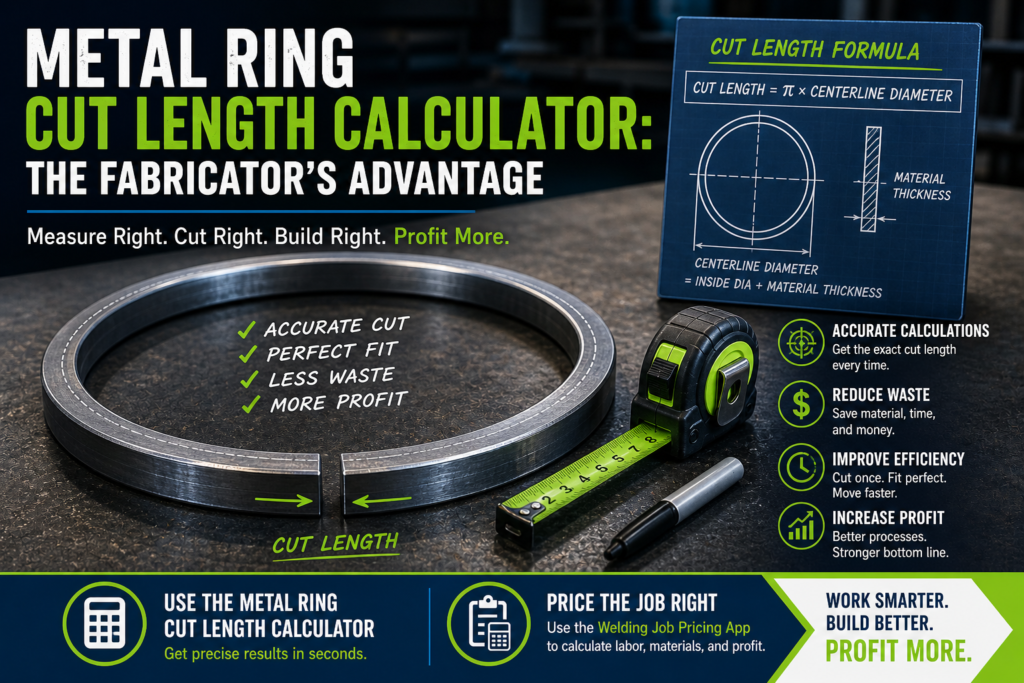
Metal Ring Cut Length Calculator: The Fabricator’s Advantage
There is a quiet moment in every fabrication shop—the moment just before the cut is made.
The steel is marked. The tape is set aside. The grinder hums in the background. And for a brief second, everything depends on one decision:
Is that measurement correct?
Because once the cut is made, there is no negotiation. No adjustment that does not cost time, money, or material. In fabrication, precision is not a luxury. It is the difference between profit and loss.
And nowhere is that more obvious than in ring rolling.
The Hidden Cost of Getting It Wrong
At first glance, a metal ring seems simple. Measure the diameter, calculate the circumference, cut the material, roll it, weld it, and move on.
But experienced fabricators know better.
The moment steel begins to roll, it stops behaving like a straight line. The outside of the material stretches. The inside compresses. The material resists, reacts, and shifts under pressure.
What looked like a perfect measurement can easily become a wide gap at the joint, an overlap that needs trimming, or a ring that does not match the required diameter.
That mistake is not just a small inconvenience. It creates rework, wasted material, extra labor, and lost profit.
Why Most Ring Calculations Fail
The issue is usually not the math. The issue is the reference point.
Many fabricators calculate ring length using either the inside diameter or the outside diameter. In real fabrication, that can create errors because the true working length of the material follows the centerline.
The centerline is the neutral area of the material. It sits halfway through the material thickness. When the ring is rolled, the outside stretches and the inside compresses, but the centerline gives the most accurate reference for the cut length.
This is why using a proper metal ring cut length calculator is critical.
Cut Length = π × Centerline Diameter
But practical fabrication also requires allowance for trimming, welding, fit-up, and machine behavior. That is where a calculator becomes useful.
From Guesswork to Control
Modern fabrication is no longer about doing everything the hard way. The shops that grow, scale, and stay profitable are the ones that build systems around their work.
That is exactly why we created the metal ring cut length calculator .
Instead of relying on rough estimates, the calculator helps you convert your measurement into the correct centerline diameter, calculate the true circumference, add allowance, and get a practical cut length before you begin rolling.
That means less guessing, fewer wasted cuts, and more control over your fabrication process.
A Simple Example That Changes Everything
Imagine you need to roll a 12-inch inside diameter ring using 1/2-inch round bar.
If you calculate only from the 12-inch inside diameter, your material length will likely come up short.
The calculator accounts for that difference automatically and gives you the correct cut length before rolling.
The result is simple: the ring closes better, the weld joint lines up cleaner, and the job moves forward with fewer corrections.
Where This Applies in Real Fabrication
You may need a metal ring cut length calculator for:
- Decorative gate circles
- Stainless steel railing designs
- Rolled flat bar rings
- Pipe rings
- Structural ring supports
- CNC plasma-cut parts
Any time metal forms a circle, accuracy at the cut stage determines everything that follows.
Precision Is Only Half the Equation
Getting the cut length right is important, but it does not guarantee the job is profitable.
That is why you should also use the Welding Job Pricing App .
It helps you calculate labor, materials, consumables, and profit so you can quote jobs correctly.
Final Thought
Every project begins with a cut.
And every cut carries a decision.
You can guess and accept the cost, or you can calculate and take control.
Use the metal ring cut length calculator and build with confidence.
