
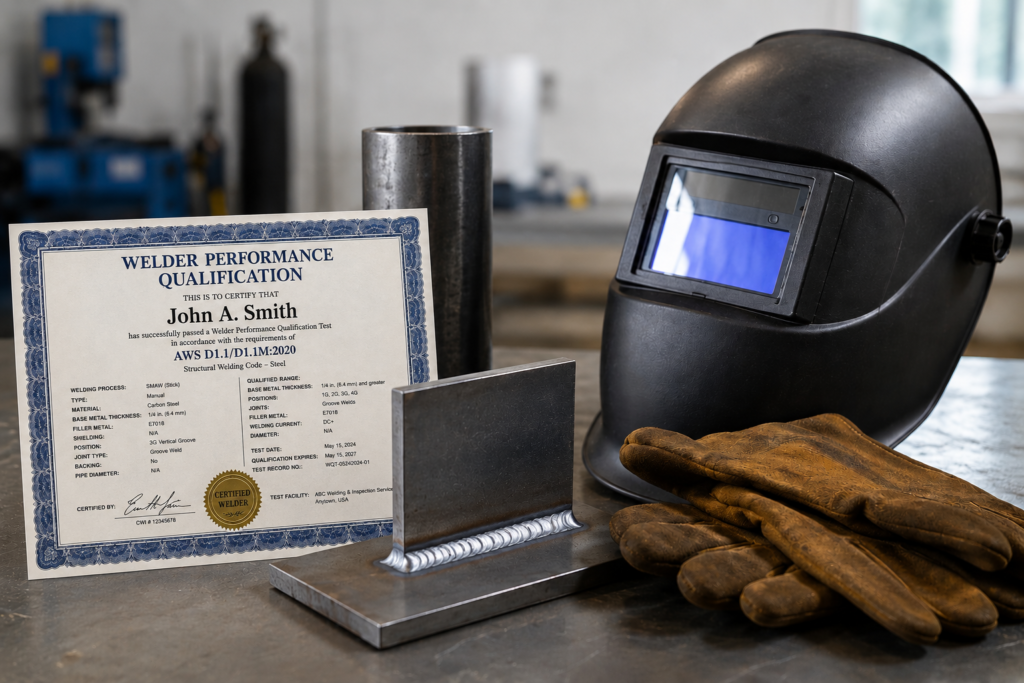
Are you thinking about traveling to another country to get your welding certification?
Before you spend thousands of dollars on tuition, travel, accommodation, and testing fees, there’s one question you need to ask yourself:
Do you actually need to be certified, or do you first need to become qualified?
Unfortunately, many new welders—and even experienced ones—don’t fully understand the difference. They hear the words qualified and certified used interchangeably and assume they mean the same thing. They don’t.
That misunderstanding can lead to spending money on certifications that don’t advance your career, while overlooking the skills that employers actually value.
When I started my own welding journey, I also believed that certification was the goal. Like many others, I thought that once I earned a certificate, opportunities would automatically appear.
Years later, after working in fabrication, structural welding, stainless steel, aluminum, repairs, and custom manufacturing, I realized something important:
A certificate may help open a door, but your skill determines whether you stay in the room.
If you’re considering becoming a professional welder, planning to work overseas, or wondering whether you should travel to another country for certification, this article will help you make a much more informed decision.
Qualification vs Certification: What’s the Difference?
The easiest way to understand it is this:
Qualification is your ability.
Certification is proof of that ability under a specific standard.
Think about learning to drive.
You may know exactly how to drive a vehicle. You can reverse, parallel park, drive on the highway, and safely navigate traffic.
That means you’re qualified.
However, until you pass the government’s driving test and receive your driver’s license, you cannot legally prove your ability.
The driver’s license is your certification.
Welding works in a very similar way.
What Is a Qualified Welder?
A qualified welder is someone who has developed the skills necessary to produce acceptable welds.
That means they understand:
- Welding safety
- Material preparation
- Joint preparation
- Machine setup
- Heat control
- Distortion
- Welding positions
- Weld defects
- Inspection basics
- Reading drawings
- Measuring accurately
- Fitting components
- Grinding and finishing
- Material selection
Most importantly…
They consistently produce good welds.
Being qualified isn’t about owning a certificate.
It’s about whether someone can trust you to build something safely and correctly.
What Is a Certified Welder?
A certified welder has demonstrated their skills by successfully completing a welding qualification test conducted according to a recognized welding code or standard.
That test is usually witnessed by an examiner or inspector.
The test coupon may then be inspected visually and subjected to destructive or non-destructive testing.
If everything passes…
Documentation is issued stating exactly what that welder is qualified to weld.
Notice something important…
The certification is specific.
It doesn’t simply say:
Certified Welder
Instead it says something more like:
- Process
- Position
- Material
- Thickness
- Joint Type
- Welding Code
For example:
A person may be certified for:
SMAW (Stick)
Carbon Steel
3G Vertical Groove
AWS D1.1 Structural Code
That does NOT automatically qualify them to weld:
- Stainless steel
- Aluminum
- Pipe
- TIG
- MIG
- Flux Core
Every combination may require another qualification.
Why This Matters
Many welders proudly say,
“I’m certified.”
The better question is:
Certified to do what?
A structural steel company may require completely different qualifications than a pipeline contractor.
A shipyard may require something different again.
A food processing plant welding stainless steel pipe will likely require another qualification.
Certification isn’t universal.
The Biggest Myth in Welding
One of the biggest myths in our industry is:
Certification makes you a good welder.
It doesn’t.
Passing one test simply proves you successfully welded one test coupon under specific conditions.
That’s all.
It doesn’t automatically prove you can:
- Fabricate a gate
- Build stairs
- Install railings
- Repair heavy equipment
- Read drawings
- Fit components
- Solve fabrication problems
- Estimate jobs
- Deal with customers
Those skills come from experience.
A Real Example
Imagine two welders.
Welder A
Has five certificates.
Cannot read a drawing.
Cannot measure accurately.
Needs constant supervision.
Makes poor fit-ups.
Welder B
Has no certificate.
Has ten years building:
- Gates
- Railings
- Structural frames
- Equipment repairs
- Trailers
- Stainless steel fabrication
Every project is accurate.
Customers recommend him.
His work rarely needs repairs.
Which welder would you hire?
Most employers would choose Welder B.
Now imagine Welder B completes the required certification test.
Now he has both.
That’s the ideal combination.
Why Companies Test You Again
Many new welders become frustrated when they apply for a job.
“I already have my welding certificate.”
“So why do I have to take another welding test?”
Simple.
The company doesn’t know you.
Your certificate tells them what happened on one particular day.
They want to know whether you can still perform today.
That’s why many employers perform their own welding tests before hiring.
Does Certification Expire?
Many welders don’t realize this.
Depending on the certification program and employer requirements, continuity must often be maintained.
If you stop welding using the qualified process for an extended period, you may need to requalify.
Even when a certification remains active under continuity rules, many employers will still require another practical test before hiring.
That’s normal.
Why I Believe Qualification Comes First
Imagine two people.
Person One spends $4,000 traveling overseas for certification.
Person Two spends that same money buying:
- A quality welder
- Safety gear
- Steel
- Grinding discs
- Measuring tools
Then practices every day for six months.
Who becomes the better welder?
Usually…
The person who practiced.
Skill is built through repetition.
Certification simply documents that skill.
Different Welding Careers Require Different Certifications
Not every welder needs the same qualification.
Structural Welding
Usually involves:
- Buildings
- Warehouses
- Bridges
- Steel frames
Common processes:
- Stick
- Flux Core
Pipe Welding
Usually involves:
- Refineries
- Oil & Gas
- Chemical Plants
- Food Industry
Common processes:
- TIG Root
- Stick Fill
- TIG Only
Stainless Steel Fabrication
Often includes:
- Railings
- Kitchens
- Food equipment
- Pharmaceutical equipment
Usually requires excellent TIG skills.
Aluminum Fabrication
Often includes:
- Boats
- Truck bodies
- Railings
- Tanks
Usually requires MIG or TIG aluminum.
General Fabrication
This is where many Caribbean welders work.
Projects include:
- Gates
- Burglar bars
- Staircases
- Fences
- Structural frames
- Equipment repairs
- Trailer fabrication
- Decorative metalwork
In many of these jobs…
Customers care more about quality than certification.
Should Caribbean Welders Chase Certification?
It depends on your goal.
If you plan to:
- Work in Saint Lucia
- Start your own fabrication business
- Build gates
- Install railings
- Repair equipment
Then becoming highly qualified may provide a much greater return than immediately chasing certifications.
However…
If your goal is:
- Offshore
- Oil & Gas
- Shipbuilding
- Nuclear
- Pipeline
- Heavy Industrial
Then certification becomes much more important.
Salary Comparison
Approximate U.S. salaries:
Entry-Level Welder
$38,000–$50,000 annually
General Fabricator
$45,000–$65,000
Structural Welder
$55,000–$85,000
Pipe Welder
$70,000–$120,000+
Shutdown Pipe Welder
Often exceeds $150,000 annually with overtime.
Certified Welding Inspector (CWI)
Approximately $80,000–$130,000+
Specialized inspectors in oil & gas, offshore, or nuclear industries may earn considerably more.
Remember…
Higher salaries usually come from:
- Experience
- Difficult work
- Travel
- Productivity
- Reliability
—not simply owning certificates.
The Skills That Actually Increase Your Value
Want to become difficult to replace?
Learn more than welding.
Become good at:
- Blueprint reading
- Measuring
- Layout
- Material selection
- Fabrication
- Equipment maintenance
- Problem solving
- Estimating
- Customer service
- Project management
The highest-paid people in fabrication rarely only weld.
They solve problems.
Common Mistakes New Welders Make
Mistake #1
Thinking certification automatically guarantees employment.
It doesn’t.
Mistake #2
Getting certified in a process they never use.
Mistake #3
Ignoring fabrication.
Many companies need fabricators more than welders.
Mistake #4
Focusing only on laying pretty beads.
Customers buy finished products.
Not welding beads.
Mistake #5
Thinking learning stops after certification.
The best welders never stop learning.
So… Should You Get Certified?
Yes…
If it supports your career goals.
No…
If you’re chasing a certificate simply because someone told you you needed one.
Start by asking yourself:
- What type of welding do I want to do?
- What industry do I want to work in?
- What processes will I actually use?
- Do employers in that industry require certification?
- Will this certification increase my income?
If you can’t answer those questions yet…
Spend more time learning the trade.
Final Thoughts
The welding industry needs more than people who can pass a test.
It needs professionals who can think, solve problems, fabricate accurately, work safely, communicate effectively, and produce quality work consistently.
Certification has tremendous value when it’s required and when it matches your career path.
But never forget this:
Certification proves what you demonstrated on one day. Qualification is what you demonstrate every day.
Build your skill first.
Build your reputation second.
Earn the certifications that support your goals.
When you combine qualification, experience, professionalism, and the right certifications, you’ll have something far more valuable than a piece of paper—you’ll have a career that can take you anywhere.
Continue Learning with Progressive Welding Solutions
At Progressive Welding Solutions, our mission is to help welders and fabricators build real-world skills that lead to better careers and stronger businesses. Whether you’re just starting out or have years of experience, you’ll find practical guides, fabrication tips, welding calculators, product reviews, and industry insights designed by people who work in the trade.
Explore more free resources at:
Because becoming a great welder isn’t about collecting certificates—it’s about continually improving your knowledge, your skills, and the value you bring to every project.
