
If you’ve just started learning stick welding (SMAW), you’ll hear experienced welders say things like, “Keep a tight arc,” or “Your arc is too long.” While it may sound like a small detail, the arc gap is one of the most important fundamentals in welding.
Many beginner welders struggle with poor-looking welds, excessive spatter, sticking electrodes, and lack of penetration—not because their machine settings are wrong, but because they haven’t yet learned to control the arc gap.
This guide explains what the arc gap is, why it matters, and how you can develop the skill to maintain it consistently.
What Is the Arc Gap?
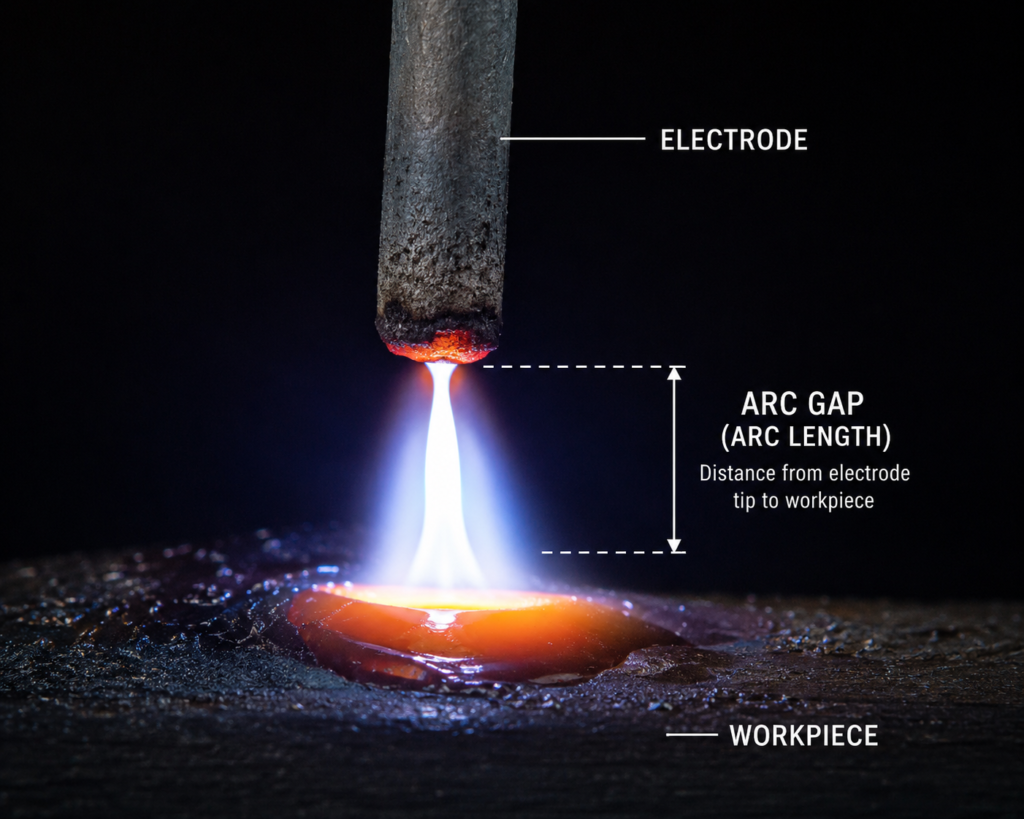
The arc gap, also called the arc length, is the distance between the end of the electrode and the surface of the workpiece while welding.
When electricity jumps across this gap, it creates the welding arc that melts both the base metal and the electrode.
Think of the arc gap as the bridge that transfers heat from your welding machine to the metal. If that bridge is too long or too short, the quality of the weld changes dramatically.
Why Is the Arc Gap So Important?
Maintaining the correct arc gap affects nearly every part of the welding process.
1. Arc Stability
A proper arc gap produces a smooth, steady arc.
A long arc becomes unstable, causing the arc to wander and produce excessive spatter.
A very short arc can cause the electrode to stick to the workpiece.
Stable arcs are easier to control and produce cleaner welds.
2. Penetration
Penetration is how deeply the weld fuses into the base metal.
A proper arc gap allows the heat to penetrate the joint effectively.
If the arc is too long, much of the heat is lost, resulting in shallow penetration and possible lack of fusion.
3. Weld Bead Appearance
A consistent arc gap creates:
- Uniform bead width
- Smooth ripples
- Better bead profile
- Less cleanup afterward
Inconsistent arc lengths usually create uneven, unattractive welds.
4. Spatter
One of the biggest frustrations for beginners is excessive spatter.
A long arc causes molten metal droplets to scatter around the weld.
Maintaining a shorter, controlled arc greatly reduces spatter.
5. Shielding Protection
In stick welding, the electrode coating produces shielding gases that protect the molten weld pool from oxygen and nitrogen in the atmosphere.
When the arc becomes too long, this protective shield becomes less effective.
This can lead to:
- Porosity
- Weak welds
- Contamination
What Happens When the Arc Is Too Long?
A long arc usually produces:
- Loud, harsh arc sound
- Excessive spatter
- Wide, flat weld bead
- Reduced penetration
- More difficult puddle control
- Increased chance of porosity
Many beginners naturally pull the electrode away because they are afraid it will stick.
Ironically, this often creates even more problems.
What Happens When the Arc Is Too Short?
A very short arc can cause:
- Electrode sticking
- Difficult arc starts
- Slag inclusions
- High, narrow weld beads
- Poor visibility of the puddle
The goal isn’t the shortest arc possible.
The goal is a consistent arc.
How Long Should the Arc Gap Be?
A general rule for stick welding is:
Maintain an arc length approximately equal to the diameter of the electrode’s core wire.
Examples:
| Electrode | Approximate Arc Length |
|---|---|
| 3/32 in (2.5 mm) | About 3/32 in |
| 1/8 in (3.2 mm) | About 1/8 in |
| 5/32 in (4.0 mm) | About 5/32 in |
This is only a guideline.
As your skills improve, you’ll learn to adjust the arc slightly depending on the electrode type and welding position.
Learn to Watch the Weld Pool
Many beginners focus on watching the tip of the electrode.
Professional welders focus on the molten weld pool.
The puddle tells you everything:
- Is it flowing smoothly?
- Is it penetrating the joint?
- Is it staying the correct size?
- Is it becoming too fluid?
Your eyes should spend more time watching the puddle than the electrode itself.
Listen to the Arc
Stick welding isn’t only visual.
It also has a sound.
A properly maintained arc typically sounds like:
Bacon frying in a pan.
If the sound becomes:
- Loud and erratic
- Popping excessively
- Constantly changing
Your arc length is probably changing as well.
Many experienced welders can tell whether your arc is too long simply by listening.
Beginner Practice Exercise
One of the best ways to improve your arc control is to practice running beads on flat steel.
Try this exercise:
- Use a flat steel plate.
- Strike the arc.
- Focus only on maintaining the same arc gap.
- Don’t worry about weaving.
- Run straight beads from one end to the other.
Repeat until the arc feels smooth and consistent.
This simple exercise builds muscle memory that will improve every weld you make.
Common Beginner Mistakes
- Pulling the electrode away from the workpiece
- Looking at the arc instead of the weld pool
- Moving too fast
- Moving too slowly
- Allowing the arc length to change as the electrode burns shorter
- Panicking when the electrode begins sticking
Every welder experiences these challenges when learning.
The key is consistent practice.
Final Thoughts
Mastering the arc gap is one of the biggest milestones in learning stick welding.
Machine settings, electrode selection, and travel speed all matter—but none of them can compensate for poor arc control.
The more consistently you maintain the correct arc gap, the more stable your arc becomes, the cleaner your welds look, and the stronger your welds will be.
Every professional welder once struggled with arc length. With practice, maintaining the correct arc gap becomes automatic, allowing you to focus on producing high-quality welds with confidence.
Ready to improve your welding skills? Follow the Progressive Welding Solutions blog for practical welding guides, fabrication tips, and step-by-step tutorials designed to help beginners become confident, skilled welders.
