
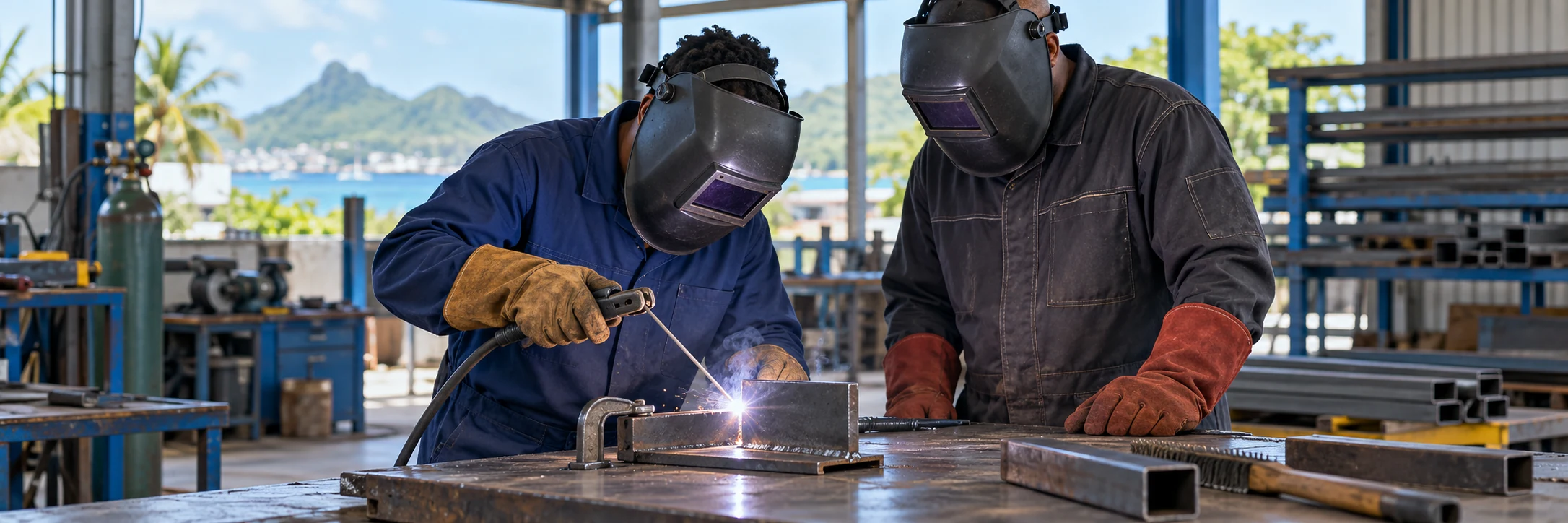
PWS practical welding programme · Saint Lucia
Build welding skills through hands-on work.
A 30-day introduction to welding and fabrication in a working workshop. Start with the basics and build practical experience as your skills develop.
Beginners welcome · Five trainees per batch · Vieux Fort, Saint Lucia
A practical route into the trade
This programme is designed for people ready to learn, work and develop a useful trade skill. You need commitment, discipline and willingness to take part in practical workshop activities.
Week 1
Build the basics
Get familiar with basic welding and fabrication tasks through practical instruction and practice.
Week 2
Apply your skills
Move into practical tasks and exposure to real fabrication work as you progress.
Weeks 3–4
Develop experience
Keep practising and contribute to workshop projects appropriate to your developing ability.
What you’ll work on
- Basic welding skills and workshop practice.
- Fabrication tasks and working with metal components.
- Practical projects in a real working environment.
The aim is to help you build skills that can lead to paid work. Progress and earning opportunities depend on your ability and the work available.
Check the next intake
Batches are limited to five trainees. Send an application so PWS can discuss the next start date, schedule, programme costs and any work arrangements with you.
Submitting an application does not confirm a place.
Send your applicationBefore you apply
Do I need welding experience?
No previous experience is required. Tell us your current experience level in the application.
Will I be earning within 30 days?
The programme develops practical skills and exposure to real work. Paid opportunities depend on progress and available jobs; PWS will discuss the arrangements with you.
When does the next batch start?
Contact PWS or apply below to confirm the current schedule and available places.
Questions before applying? Contact PWS. Read our privacy policy for information about handling your enquiry.
PWS ONLINE LEARNING / BEGINNER FOUNDATIONS
Safety, qualifications & working life
Learn what comes before the first weld. Work through short illustrated lessons, discuss a real-work scenario and check your understanding. Use this introductory course online or alongside instructor-led practical classes.
COURSE 1 / LESSON 1
Your first step into fabrication
This introductory course covers workshop safety, welding qualifications and what beginners should expect at work. Read each lesson, answer the scenarios and complete the self-check. Powered practice needs instruction and supervision.
COURSE 1 / LESSON 2
How the project stages fit together
The proposed PWS series follows a job: safety; tools and equipment; drawings, measuring and layout; materials and planning; cutting and preparation; fitting and tacking; welding; inspection; finishing; installation and handover. Only Course 1 is available here now.
COURSE 1 / LESSON 3
The work around the weld
A fabricator checks instructions, dimensions and materials before making anything. Preparation, fitting, inspection, finishing and handling are part of the job. Report mistakes or missing information before continuing. A neat weld cannot correct the wrong dimensions.
COURSE 1 / LESSON 4
The job brief
Confirm the item, dimensions, units, current drawing, material and finish. Find out how the work will be checked. If a detail is missing or conflicts with another instruction, ask the supervisor before cutting. Do not invent a missing structural detail.
COURSE 1 / LESSON 5
Course completion and qualifications
A completion certificate records training completed. A welder performance qualification records a successful test against specified requirements. Site or employer authorization concerns permission to do particular work. Completing this online lesson does not qualify you for a production weld.
COURSE 1 / LESSON 6
The scope of a welding qualification
Read the qualification record. The process, material, position and other variables affect its scope. The applicable code or scheme sets the limits and maintenance requirements. Ask what the employer or client accepts. There is no single certificate that automatically covers every welding job.
COURSE 1 / LESSON 7
Procedures and quality
A Welding Procedure Specification (WPS) describes how a weld is to be made. Drawings and job specifications describe the required result. Follow the applicable instructions and report conditions outside them. A qualified welder and a qualified procedure address different requirements.
COURSE 1 / LESSON 8
Hazards before the arc starts
Heat and sparks can burn people or start fires. Electricity can cause shock. Fume and gases can harm breathing. Sharp edges, moving parts and heavy steel can injure. Arc radiation can damage eyes and skin. Include helpers and people nearby in the assessment.

COURSE 1 / LESSON 9
Controls work together
Remove hazards where possible. Use safer methods and engineered protection such as extraction, guards and screens. Plan access, supervision and work rules. Wear suitable protection for remaining exposure. PPE alone does not make an unsafe work area suitable for welding.
COURSE 1 / LESSON 10
Clothing and personal protection
Protect eyes, face, hands, skin and feet for the task. Welding needs a suitable helmet and filter, safety eyewear, welding gloves, protective clothing and boots. Use clean clothing suited to sparks and heat. Check fit and condition. Follow equipment guidance for lens shade selection.

COURSE 1 / LESSON 11
Arc light and people nearby
Position welding screens to protect other people without blocking ventilation or exits. The operator and anyone observing the arc need suitable protection. Looking away is not a reliable control. Do not create a live arc for a beginner hazard-identification activity.
COURSE 1 / LESSON 12
Fume and gases
Identify the metal, coatings and consumables. Consult safety data sheets and the supervisor. Use assessed ventilation and source extraction, with your head out of the plume. An open door or outdoor work does not prove exposure is controlled. Stop if the planned controls are unavailable.

COURSE 1 / LESSON 13
Respiratory protection
Respirators require correct selection, use and maintenance. Tight-fitting types need fit testing where applicable. Air-purifying respirators do not supply oxygen. Unknown coatings, contaminated steel and enclosed areas require competent assessment before work. This lesson does not train respirator selection or confined-space entry.
COURSE 1 / LESSON 14
Fire and hot work
Check where heat, sparks and slag can travel, including through gaps and into hidden areas. Remove or protect combustibles. Confirm site permission, any required permit, suitable fire protection and fire-watch arrangements. The area can remain a fire risk after welding stops.
COURSE 1 / LESSON 15
Electrical awareness
Inspect leads, holders and connections. Keep the area and protective equipment dry. Remove damaged equipment from service and report it. Visual learning checks use disconnected equipment. Only authorized people repair electrical equipment. A welding work-return connection is distinct from protective earthing.
COURSE 1 / LESSON 16
Compressed-gas awareness
Cylinders contain stored energy. Secure and transport them with approved equipment. Read the label rather than relying on cylinder color. Keep oxygen equipment free of oil and grease. Do not improvise connections. Suspected leaks, regulator operation and cylinder changes need trained supervision.
COURSE 1 / LESSON 17
Grinders and rotating tools
Use the correct tool, guard and accessory. Check condition and speed rating. Secure the work and plan spark direction. Isolate before accessory changes. Grinding needs suitable primary eye protection plus a face shield. Keep loose clothing, jewelry and hair clear. Assess glove entanglement risk around rotating machinery.
COURSE 1 / LESSON 18
Steel handling and housekeeping
Support stock so it cannot roll, tip or fall. Keep hands clear of pinch points. Use assessed handling aids and assistance. Keep walkways, leads and exits organized. Handle cut edges and recently worked metal carefully. Do not assume a workpiece has cooled because it is no longer glowing.
COURSE 1 / LESSON 19
Jobs that need specialist controls
Stop and refer confined spaces, used tanks or drums, lifting operations, work at height, live plant and unknown coatings. An apparently empty container can contain dangerous residues. Do not enter a confined space for an unplanned rescue. These activities need specialist arrangements and training.
COURSE 1 / LESSON 20
When something goes wrong
Stop work, raise the alarm and keep clear of the continuing hazard. Follow the site emergency contacts and evacuation plan. Get trained assistance. Never touch someone still in contact with an electrical source or enter a dangerous atmosphere to help them. Report injuries, faults and near misses.
COURSE 1 / LESSON 21
Before, during and after
Before: confirm the instructions, controls and equipment. During: watch for changing conditions and other people. After: follow equipment shutdown instructions, identify hot material and complete the required area checks and monitoring. Pause and reassess when conditions change.
COURSE 1 / LESSON 22
Scenario: a gate repair
A repair is requested beside a vehicle. The gate has an unknown painted coating. Cardboard is behind it. A damaged lead crosses a damp walkway. Before continuing, write down at least five hazards or missing controls. Who must resolve them?
COURSE 1 / LESSON 23
Scenario: a suitable response
Pause and notify the supervisor. Resolve coating and fume questions. Move or protect the vehicle and combustibles. Remove the damaged lead from service. Resolve the wet area, access and bystander risks. A competent person must confirm the scope and controls before the repair starts.
COURSE 1 / LESSON 24
Scenario: the certificate
An employer asks whether completing this course qualifies you for a specified weld. Explain that you completed introductory theory. The job may require a separate practical test and accepted qualification record. Do not claim a tested process or position without the appropriate evidence.
COURSE 1 / LESSON 25
Activity without live work
Online: sketch a proposed work area and identify hazards, controls and emergency arrangements. In class: inspect an isolated station with the instructor and explain when to stop. Do not operate equipment, handle gas or enter a workshop alone to complete this assignment.
COURSE 1 / LESSON 26
Progression to practical work
The next step is an instructor-observed awareness check: explain pre-work checks, identify protection, recognize defects, locate emergency arrangements and explain your training limits. Online self-check results are for learning. They do not issue a certificate or authorize powered work.
Knowledge self-check: 10 questions
Answer every question, then check your answers. Aim for at least 8/10 and review every safety misunderstanding. Results stay in this page and are not submitted to PWS.
The full project-stage learning path
- Safety, qualifications and working life — available above.
- Shop equipment, tools and material handling — planned.
- Drawings, measuring and layout — planned.
- Materials, joints and job planning — planned.
- Cutting, drilling and joint preparation — planned.
- Fitting, checking and tack welding — planned.
- SMAW / stick welding foundations — planned.
- MIG/MAG welding foundations — planned.
- TIG welding foundations — planned.
- Weld inspection, distortion and correction — planned.
- Finishing and corrosion protection — planned.
- Delivery, installation and handover — planned.
