
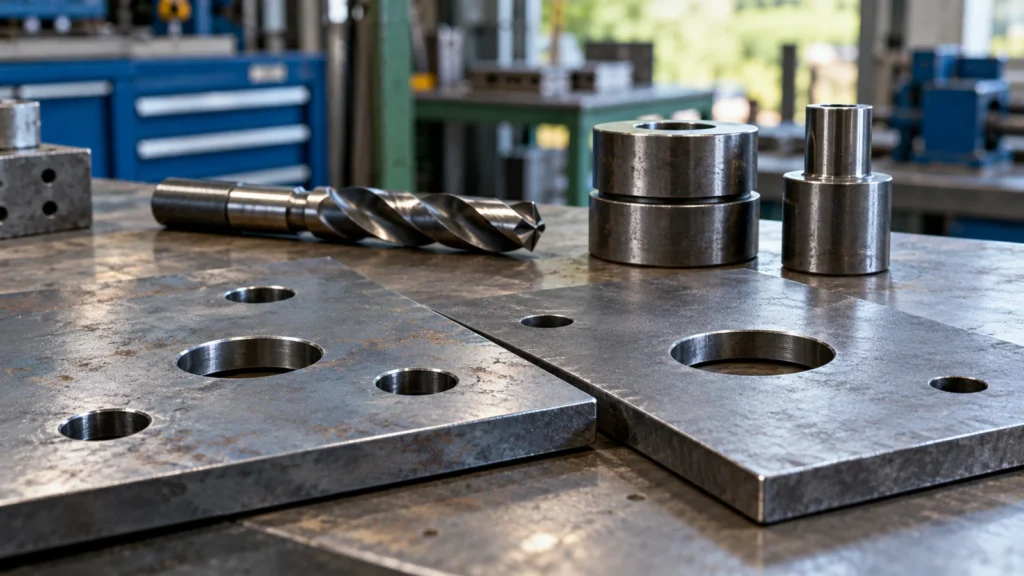
If you need holes in steel, the first useful decision is what the finished part requires. Drilling and punching are different operations, and the right choice depends on the material, geometry, equipment and quantity. Specify the result before asking which process is cheapest.
Define the hole and its purpose
State the required diameter or shape, material grade, thickness and number of holes. Explain whether a hole provides clearance for a fastener, locates a matching part, or has another function. Include any tolerance or finishing requirement already defined by the designer.
Give hole positions from clear references on the part. A dimensioned drawing is more reliable than marks on a photograph. Identify repeated patterns and distinguish between the quantity of parts and the number of holes in each part.
Review access and geometry
A punch needs compatible tooling and enough access for the material and die arrangement. Reach, section shape, hole position and machine capacity all need checking. A hydraulic punch advertised for a particular material thickness is not automatically suitable for every hole size or steel grade.
Drilling has its own access, support and workholding requirements. Holes through both walls of a section, deep holes and countersunk features should be stated explicitly. Do not assume that one operation includes every follow-on feature.
Quantity can change the production conversation
For a repeated pattern, setup and tooling can be shared across the batch. For a few different parts, marking and handling may account for more of the job. A meaningful quotation needs the total quantity and the pattern information, not just a count of holes.
Ask what the finished edges will be like and whether deburring or another finishing step is included. Where the application needs close fit or specific hole quality, have that requirement reviewed before choosing the operation.
Send the drawing before buying tooling
PWS provides drilling and hole punching as reviewed services. Send the material, drawing, quantity and timing so the proposed method can be assessed. The corresponding drilling service product and punching service product are used for approved orders after the scope is confirmed.
If you intend to buy a punch or die for your own shop, verify the exact machine-tool combination and manufacturer’s capacity information. Matching a model name alone does not settle die clearance, hole geometry or working limits.
Ask for the complete operation
Mention any cutting, bending, coating or assembly that follows. Hole positions may need to be coordinated with those operations. A complete processing brief lets the shop review the sequence, rather than discovering after punching that a flange or bend changes the requirement.
