
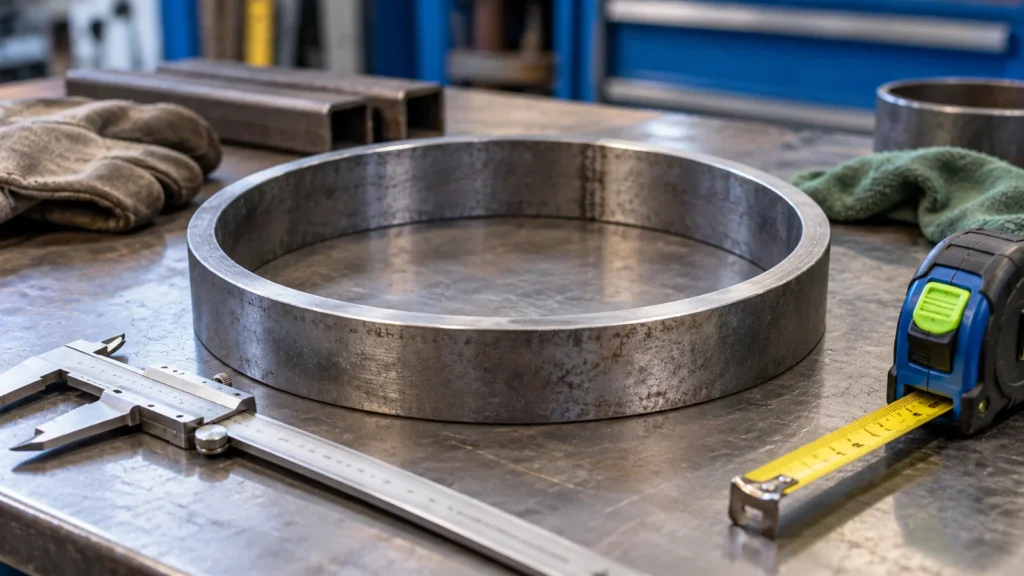
Two rings can share the same outside diameter while using different material lengths if their sections are different. That is why “make a 600 mm ring” is incomplete without a measurement reference and a material profile. Clarify those before calculating a cut length.
Three ways to describe a ring
The inside diameter measures across the clear opening. The outside diameter measures across the outer edges. The centerline diameter follows a line through the middle of the section in the radial direction.
For a simple circular band made from flat bar bent through its thickness, the centerline diameter is the outside diameter minus that thickness. It is also the inside diameter plus the thickness. The familiar circumference relationship, π multiplied by diameter, applies to whichever circular path that diameter describes.
A simple example
Suppose a flat-bar ring is required to finish at 600 mm outside diameter and the bar is 6 mm thick in the radial direction. A middle-of-thickness centerline assumption gives 594 mm diameter. Its circumference is approximately 1,866 mm. Using 600 mm in the same calculation gives about 1,885 mm—a difference of roughly 19 mm.
This example explains the geometry. It is not a guaranteed production blank length. Actual rolling behavior, the profile, end treatment, trimming, joining and the process used must still be considered.
Identify the profile and its orientation
Pipe, round tube, rectangular hollow section and flat bar are not interchangeable calculator inputs. Record the outside section dimensions and wall thickness where relevant. For a rectangular section, show which face lies in the plane of the curve.
If you need an arc rather than a full ring, state the angle or show the required endpoints and geometry on a drawing. “Half a circle” is useful context, but a dimensioned sketch is clearer when the part must fit another assembly.
Use the calculator with a visible assumption
The PWS Metal Ring Cut Length Calculator supports ring planning with defined profiles and dimensions. Read the selected measurement reference and the assumptions shown before using the output. Keep your required finished size with the calculation so it can be checked later.
When ordering tube or section rolling, send the profile, finished diameter reference, quantity and any seam or trimming requirements. PWS reviews achievable geometry and the production scope before accepting the job.
For repeat work, record the actual result and process allowance used. A tested workshop allowance for a specific section is more informative than treating a geometric circumference as a universal rolling rule.
