
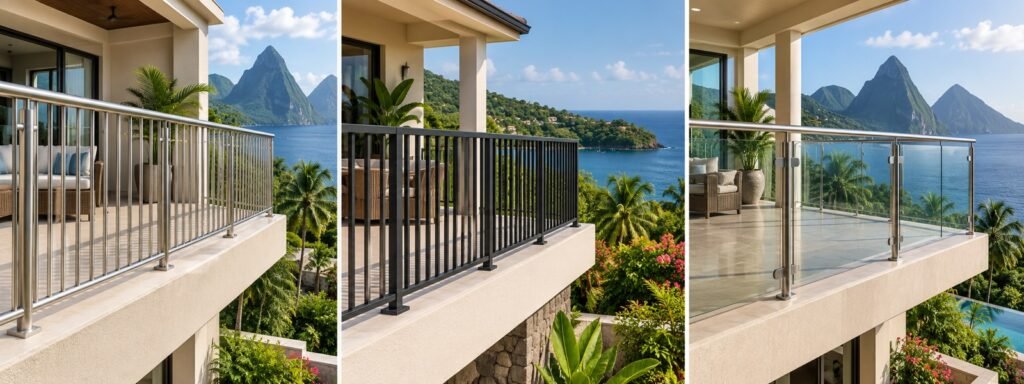
A balcony should feel like part of your home: a place to enjoy the view, welcome guests and move around comfortably. The railing helps define that space, so its appearance matters. So do the materials, cleaning access and installation details behind it.
Stainless steel, aluminum and glass can each create a finished architectural look. The best choice depends on your property, exposure, priorities and the complete system specification.
First, separate the frame from the infill
These options are not always separate categories. Stainless steel or aluminum can form the supporting posts and rails, while glass forms the panels between them. A glass railing may therefore include substantial metalwork.
When comparing designs, identify the frame material, infill, finish, fixing system and glass specification where applicable. That gives you a useful basis for comparing quotations.
Stainless steel: a visible metal finish
Stainless steel suits homeowners who like a polished or brushed metal appearance. Different profiles and infill arrangements can make the result feel traditional, contemporary or somewhere between the two.
For Saint Lucia properties, discuss the grade alongside the location. Type 316 generally offers better resistance to chloride-related pitting than Type 304. Exposure, surface finish, sheltered areas and cleaning also affect performance. A coastal address should prompt a specification discussion rather than an assumption that all stainless steel behaves alike.
Grade choice also applies to compatible fittings and fasteners. A good-looking top rail is only part of the assembly. Explore PWS stainless steel railing options to compare profiles and finishes.
Aluminum: colour and clean architectural lines
Aluminum is worth considering when you want a painted architectural appearance, such as a dark railing against light walls. It is lighter than steel, but the selected profiles, spans and connections still determine the requirements of the system.
Discuss the coating process and its suitability for the installation environment. Colour alone does not describe surface preparation, coating performance or the treatment of exposed connections. Details around dissimilar metals and fixings also belong in the specification.
Aluminum needs cleaning and periodic inspection too. Choose a layout that allows you to reach the outside faces and lower connections. See aluminum railing designs for possible starting points.
Glass: give the view more room
If a sea view, garden or open outlook is the main feature of your balcony, glass can make the boundary feel less visually busy. The supporting system may use posts, clamps or a base channel, each with its own appearance and installation requirements.
The glass build-up, panel dimensions, edge details and supporting hardware must be specified together. Toughened and laminated glass describe different characteristics; the appropriate combination depends on the selected system and project requirements. Choosing glass by thickness alone misses those relationships.
Cleaning access deserves attention before ordering. Larger clear panels show fingerprints, water marks and salt deposits. Think about how both faces will be reached, especially above ground level. Explore PWS glass railing systems to see the available visual approaches.
A practical comparison
| Priority | Option to explore | Detail to confirm |
|---|---|---|
| Visible polished or brushed metal | Stainless steel | Grade, finish and cleaning plan |
| Colour coordinated metalwork | Aluminum | Profiles, coating and connections |
| A more open view | Glass infill | Glass build-up, support system and access for cleaning |
| A mixed architectural look | Metal frame with glass or other infill | Compatibility of the complete assembly |
Compare the installation, not only the material
Two railings with the same overall length can have very different installation scopes. Corners, stairs, changes in level, waterproofing and the condition of the supporting concrete all affect the work.
The fixing arrangement needs a suitable supporting structure. Tiles and decorative finishes do not tell the whole story. Final floor levels also matter because they affect the finished railing height and the relationship between stairs, landings and adjacent openings.
Have these details reviewed before committing to a design. It is easier to coordinate them during planning than to modify an ordered system around incomplete site information.
What determines the price?
Material grade, profiles, infill, total length, corners, stairs, finish and installation conditions all influence the quotation. Glass can change handling and support requirements; a complex metal design can add substantial fabrication work. There is no reliable universal price ranking for every property.
Compare quotations with the same scope: system specification, delivery, installation, site works, lead time and exclusions. The PWS railing feasibility estimator provides an early range for its available options. Your written quotation confirms the final price.
Choose around the way you use your home
Start with three questions: What do you want to see when you step outside? How exposed is the location? What cleaning routine will be practical over time?
Then share photographs, approximate dimensions, your community and a few designs you like. PWS supplies railings as complete design, supply and installation packages, coordinating the selected system with your property.
Ready to finish your balcony or stairs? Discuss your railing project or book a site assessment. You can also compare the PWS railing range before choosing a direction.
Technical reading: worldstainless corrosion resources and Viewrail’s glass railing overview. Project specifications are confirmed separately.
Cover image: AI-generated design comparison; it does not show completed PWS installations.
