
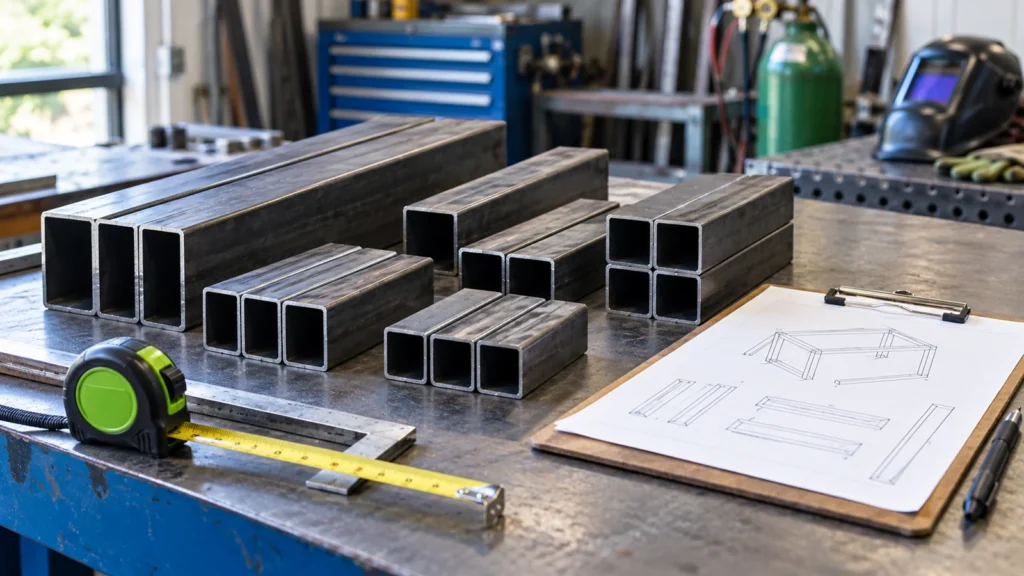
A cut list is a set of instructions, not just a total length of steel. “Twenty feet of tube” may describe what you want to purchase, but it does not explain the separate parts that must be cut. Give each required part enough information to be identified and checked.
Use one row for each distinct part
Start with a part reference such as A1 or B2, followed by the material profile, section dimensions, wall thickness, quantity and finished cut length. Add the grade if it is specified. Keep different sections or wall thicknesses on different lines, even when their lengths are the same.
For example, “A1: 50 × 25 × 2 mm RHS, four pieces, 900 mm finished length, square ends” describes the requirement more clearly than “cut four lengths for a frame.” The example is a communication format, not a recommended structural section for your project.
Define how an angled part is measured
An angled cut needs more than the word “miter.” State the angle at each end and explain the length reference: long point, short point or centerline. A sketch can show whether the cuts face the same direction or oppose each other.
Include the required orientation for unequal rectangular sections. The same cut angle can produce a different-looking part when the section is turned. If parts are handed or mirrored, identify them separately rather than assuming the cutter will infer the arrangement.
Keep stock information separate
Say whether you are supplying stock or asking PWS to supply it. If you provide material, state the available lengths and condition. Do not add an assumed kerf allowance to every finished dimension unless that method has been agreed. The cutter needs the finished part dimensions and can review the cutting allowance and stock arrangement.
Small differences matter when a list is repeated across many pieces. Add tolerances where the job needs them and discuss whether the proposed cutting process can meet those requirements.
Check the list against the assembly
Count the parts on your drawing, then compare them with the list. Check units, duplicated references and revised dimensions. Give the drawing and cut list the same revision date or identifier so an earlier length does not accidentally remain in circulation.
Use the PWS Steel Cutting service to submit the list, material details and preferred timing. Its service product is used for an approved order after the scope is confirmed.
If the pieces also need holes, bends or welding, include the full drawing and sequence. PWS can review a combined material-processing scope, rather than treating each operation as an unrelated request.
